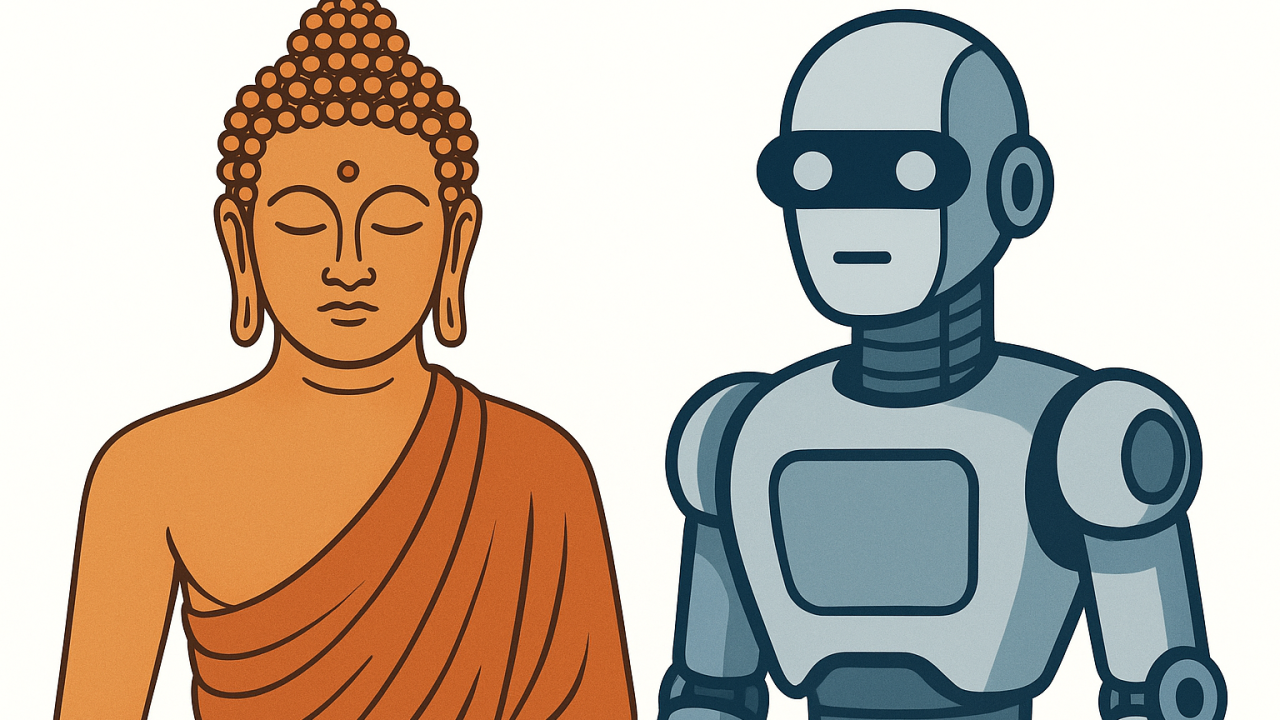
We already have AIs that think in public. What we lack are AIs that know when to pause.
Buddhi is the engine—fast, powerful, analytical. It parses data, evaluates options, chains logic. Viveka is the judgment that knows when to apply the brakes: the ability to discriminate between what can be computed and what should be said. Buddhi says “I can answer this.” Viveka asks “But should I? Is this response appropriate? Is it actually true? Will it help?”
In classical Indian philosophy, Buddhi (pronounced “bood-hee”) is the faculty of intellect and understanding—the part of mind that processes information, draws conclusions, and makes decisions. Think of it as your analytical processor: it takes in perception, memory, and inference, then produces judgments and plans.
Viveka (pronounced “vee-vay-kah”) means discriminative wisdom—the ability to distinguish between what seems true and what is true, between what can be done and what should be done. It’s the discernment that knows when your brilliant analysis is actually missing something crucial, when your confident conclusion needs to be questioned, when silence is wiser than speech.
Together, they form a complementary pair: Buddhi is intellectual power, Viveka is wise judgment. Buddhi alone can become mere cleverness—an engine generating conclusions without wisdom. It requires Viveka to function properly. This ancient distinction maps remarkably well onto a critical gap in modern AI systems.
What Buddhi Looks Like in Today’s Language Models
Current language models excel at Buddhi. They chain thoughts together, follow complex logic, explore multiple reasoning paths, and arrive at solutions. Techniques like chain-of-thought prompting amplify this capacity, producing models that solve arithmetic problems, logical puzzles, and structured tasks with impressive accuracy.
Yet these same models regularly overstate their certainty. They assign high confidence to wrong answers—a calibration problem that researchers have documented extensively. A model might express 90% confidence while being correct only 60% of the time.
The deeper issue is truthfulness. Trained on vast amounts of human text, models learn statistical patterns of language without the epistemic commitments that underlie genuine knowledge. Without specific incentives for honesty, language models will reproduce misinformation or generate plausible-sounding fabrications simply because those patterns appear in their training data.
The result: Buddhi enables reasoning but not judgment. Models generate answers without knowing when those answers shouldn’t be shared.
The Missing Viveka Gate
We need a mechanism rooted in this classical insight: a Viveka Gate that every output must pass through before reaching the user. This isn’t metaphorical—it’s a concrete system requirement. Before producing a response, the model must evaluate three dimensions:
- Truth: Is this answer actually supported by evidence? How confident should we genuinely be?
- Integrity: Is this output safe, appropriate, and aligned with relevant ethical boundaries?
- Purpose: Does this response advance the user’s actual goal, or is it just fluent noise?
When the answer to any question is “not yet” or “insufficient,” the model should pause. It can request more information, clarify assumptions, acknowledge uncertainty, or decline to answer. This isn’t a failure—it’s discriminative judgment in action.
Why This Matters: Three Scenarios
Medicine: Consider an AI assistant evaluating pneumonia symptoms. A Buddhi-only system outputs a confident antibiotic recommendation. A Viveka-guided system cross-checks current clinical guidelines, notices that major sources diverge for this specific presentation, and requests additional information: oxygen saturation levels, allergy history, recent chest imaging. It states its confidence level clearly, cites its sources, and declines to make treatment recommendations until critical information is available. That pause becomes a safeguard.
Finance: An investor sees a tweet about a potential merger and asks an AI for analysis. The Buddhi model generates a fluent assessment based on the claim. The Viveka-guided system checks regulatory filings, finds no corroborating evidence, and instead provides a framework for verification: what sources to check, what timeline to expect for real news, what signals would confirm or refute the rumor. It refuses to amplify unverified information. That hesitation protects decision-making.
Public Policy: A government AI tool must draft a response to a complex multi-stakeholder issue. The Buddhi model synthesizes available reports into coherent recommendations. The Viveka-guided version identifies missing legal constraints, flags which policy frameworks apply (such as OECD AI principles or GDPR requirements), and explicitly notes which assumptions require human confirmation. It doesn’t just summarize—it surfaces the boundaries of its own knowledge.
In each case, the system that knows when not to speak provides more value than the system that always speaks.
Context Matters: Configurable Thresholds
Judgment is context-dependent. A creative writing assistant doesn’t need the same truth threshold as a medical advisor. A government deployment requires higher integrity standards than a casual chatbot. The Viveka Gate must be context-sensitive and transparent.
Truth can be measured through retrieval confidence scores and uncertainty quantification. Integrity can be enforced through policy alignment and safety filters. Purpose requires checking whether the response actually serves user intent or merely sounds helpful.
These thresholds should be visible to users, adjustable by deployers, and tied to real-world governance frameworks. When people can see and understand these boundaries, trust becomes possible.
The Cultural Shift: From Oracle to Collaborator
The deeper value of Viveka is cultural. When AI systems openly acknowledge uncertainty, cite the basis for their judgments, and signal when they’re unsure, they stop performing confidence at us and start collaborating with us. Users become co-agents in a shared reasoning process rather than passive consumers of machine-generated certainty.
This creates a fundamentally different relationship. It makes space for productive doubt—a virtue in high-stakes decisions. It trains users to ask better questions, provide better context, and recognize the limitations of automated reasoning.
This shift redefines AI’s societal role: not as oracles dispensing answers, but as tools that amplify human judgment rather than replacing it.
Building Blocks Already Exist
Many components needed for Viveka are emerging in current research. Process supervision rewards models for correct reasoning steps, not just correct answers. Self-consistency techniques reduce hallucination by having models verify their own outputs. Work on uncertainty quantification, truthfulness benchmarks, and constitutional AI provides technical infrastructure for implementing these ideas.
What’s missing is an organizing principle—a clear framework that connects these disparate efforts. The Viveka Gate offers such a framework: a bridge between ancient philosophical insight and contemporary AI engineering.
A Simple Rule for Complex Systems
Before any output is released, it must pass three checks:
- Truth: Is it supported by evidence and appropriately calibrated?
- Integrity: Is it ethical, legal, and contextually appropriate?
- Purpose: Does it genuinely help the user right now?
This is the discipline Viveka instills.
If Buddhi gives a model the power to answer, Viveka gives it the wisdom to remain silent—until speaking becomes genuine service rather than mere performance.
Viveka transforms AI from a noisy oracle into a trusted guide.
References
- Ādi Śaṅkara, Vivekacūḍāmaṇi — Classical Advaita Vedānta text on discriminative knowledge
- Encyclopædia Britannica: Buddhi in Indian philosophy – https://www.britannica.com/topic/buddhi
- Wang et al., “Self-Consistency Improves Chain-of-Thought Reasoning in Language Models” – arXiv:2203.11171
- Guo et al., “On Calibration of Modern Neural Networks”, ICML 2017
- Lin et al., “TruthfulQA: Measuring How Models Mimic Human Falsehoods” – arXiv:2109.07958
- Gal, Yarin. Uncertainty in Deep Learning. PhD Thesis, University of Cambridge
- OECD Principles on AI – https://www.oecd.org/going-digital/ai/principles/
- European Commission, Ethics Guidelines for Trustworthy AI (2019)
- OpenAI, “Improving Mathematical Reasoning with Process Supervision” (2022)
- OpenAI, GPT-4 Technical Report (2023)
#AI #Ethics #Philosophy #Buddhi #Viveka #ArtificialIntelligence #ResponsibleAI #MachineWisdom #AIandHumanity #DigitalTransformation #AITrust #TechPhilosophy #ConsciousTechnology
Nota sull’uso di IA: l’autore ha utilizzato strumenti di IA generativa (ChatGPT, Claude, Perplexity) come supporto alla scrittura e ha interamente rivisto e approvato il testo finale.